
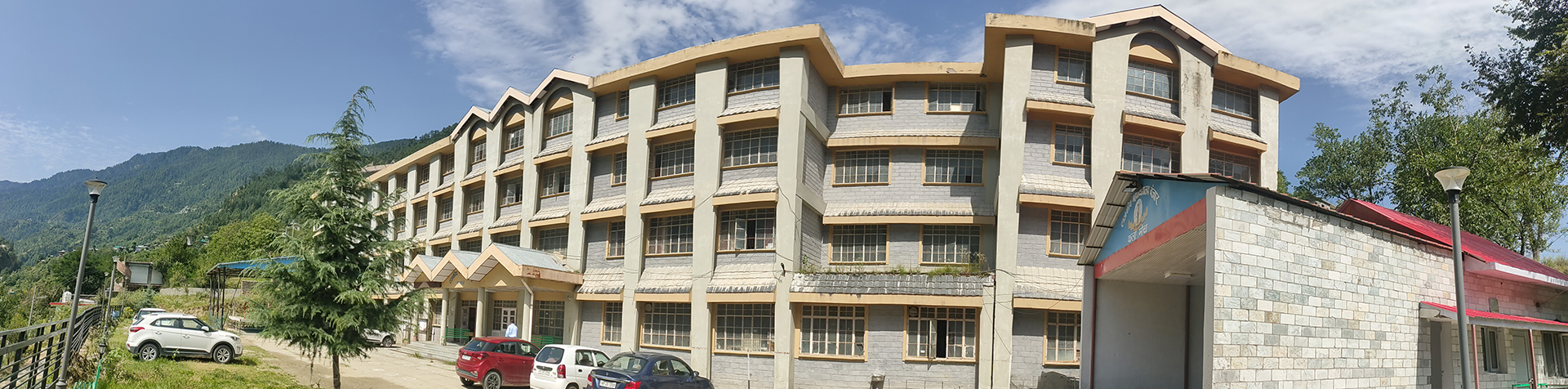
Department of physics
Courses Offered & Outcomes
Course Specific Learning Objectives (CLOs):
List of Physics Courses with Course learning objectives (CLOs):
B. Sc 1st Year
Mechanics:
CLO1: Understand the various co-ordinate systems, motion of objects in different frame of references and transformation laws- Both Galilean and Lorentz transformations.
CLO2: Understand laws of motion and its applications i.e. projectile motion, simple harmonic oscillator, Rocket motion, elastic and inelastic collisions.
CLO3: Understand the idea of conservation of angular momentum, central forces and the effective potential.
CLO4: Develop understanding of special theory of relativity and its applications to understand length contraction, time dilation, conservation of momentum and variation of mass, relativistic momentum, energy, and mass energy relation.
CLO5: Understand the application of central force to the stability of circular orbits, Kepler’s laws of planetary motion, scattering.
CLO6: Understand the dynamics of rotating objects i.e. rigid bodies, angular velocity, the moment of inertia, the motion of rigid bodies. Non-inertial frames: Pseudo forces, examples involving the centrifugal force and Coriolis force.
Electricity and Magnetism:
CLO1: To understand the basic concepts of Electric field, Electric Potential and current.
CLO2: To learn and understand the magnetic field and magnetic properties of the matter.
CLO3: Understand the concept of static and time varying fields.
CLO4: Understand the concept of conductors, dielectrics and capacitance.
CLO5: Gain knowledge on EM waves using use Maxwell’s equations, propagation and their properties and concept of Poynting vector.
CLO6: Ability to describe and make calculations of plane electromagnetic waves in homogeneous media, including reflection and transmission of such waves in boundaries.
B. Sc 2nd Year
Waves and Oscillations:
CLO1: Understand the concepts of SHM, mechanical and electrical Oscillators and able to derive their mathematical equations and solutions.
CLO2: Able to solve wave equation of damped, forced and coupled oscillators for heavily and lightly damped oscillators.
CLO3: Understand how several waves or parts of waves interact, and be able to calculate and analyze diffraction and interference phenomena, and explain the conditions required for such phenomena to appear.
CLO4: Analyze different types of diffraction and interference and their applications.
CLO5: Able to calculate what happens when waves move from one medium to another, and be able to explain dispersion and group and phase velocity.
CLO6: Able to solve wave equation for polarization and understand the concept of half and quarter wave plates.
Thermal and Statistical Physics:
CLO1: Understand the basic statistical methods and concepts like probability, random variables, expected value, variance, and common probability distributions.
CLO2: Familiarize in depth about statistical distribution and have basic ideas about Maxwell-Boltzmann, Bose-Einstein and Fermi Dirac Statistics and their applications.
CLO3: Ability to evaluate entropy changes in a wide range of processes and determine the reversibility or irreversibility of a process from such calculations.
CLO4: Become familiar with various thermodynamic process and work done in each of these processes. Understand the efficiency of Carnot’s engine and the significance of first law and second of thermodynamics and implications of the second law of thermodynamics.
CLO5: Understand the interrelationship between thermodynamic and statistics and ability to use such relationships to solve practical problems. Realize the importance of Thermo dynamical functions and applications of Maxwell’s Thermodynamical relationships.
CLO6: Understand the methods of production of very Low temperature. It also exposes the production of Low temperature, superconductors and methods of liquefaction of gas.
B. Sc Final Year
SOLID STATE PHYSICS:
CLO1: Learn about the basic concepts of crystal structures, Bravais Lattices, packing fractions, diffraction experiments and reciprocal lattices.
CLO2: Understand crystal vibrations: phonon, heat capacity and thermal conductivity
CLO3: Able to classify materials depending on band gap, effective masses, charge carrier distributions, doping, p-n junctions, ,
CLO4: Understand free electron Fermi gas: density of states, Fermi level, and electrical conductivity.
CLO5: Establish the relationship between conductors and insulators and super conductivity.
CLO6: Know the properties of superconductors; types, properties, London equations, BCS theory and applications of superconductors.
Elements of Modern Physics:
CLO1: To learn about origin of quantum mechanics/modern physics, Planck’s Theory, Blackbody spectrum, and UV catastrophe.
CLO2: Understanding the particle nature of light using Photo-electric effect, and Compton Scattering.
CLO3: To understand wave nature of light using De-Broglie hypothesis and Davisson and Germer Experiment.
CLO4: To understand the concept of Matter wave and uncertainty principle.
CLO5: To learn some basics of Quantum Mechanics, Schrödinger wave equation, wave-function and Born’s interpretation of wave function.
CLO6:To apply Schrödinger wave equation for Quantum mechanical scattering and tunneling in one dimension - across a step potential and across a rectangular potential barrier.
Nuclear Physics:
CLO1: Understand the ideas of basics of nucleus, its properties and binding energy.
CLO2: Able to know about the magic numbers and different types of nuclei.
CLO3: Understand the various decay modes viz. alpha, beta and gamma decay.
CLO4: Ability to have insight into various types nuclear reactions, their conservation laws, Q- value, and formation of compound nucleus.
CLO5: Understand basic knowledge accelerators and detectors; their construction and applications.
CLO6: Ability to apply fundamental conservation laws and symmetries to judge the viability of production and decay processes for nuclei and elementary particles.
PHYSICS PRACTICALS and CLOs
This laboratory based course provides the ‘hands on’ experience in a number of experimental techniques, and develops competence in the instrumentation typically used in Physics. The courses assume a familiarity with optics and electromagnetism, mechanics, thermodynamics and statistical Physics and solid state physics. The various practical in Physics lab helps students to realize theoretical concepts in real practice via experimentation.
There are various experiments in Physics Lab according to almost every course subject which are aimed to provide students experimental knowledge. Some of the important experiments are given below. The students will be able to;
CLO1: To learn the mechanics of Fly wheel, bar, Kater’s pendulum, Digital Timer technique for measuring acceleration due to gravity, use of Sextant.
CLO2: To acquire the knowledge of electrical devices such as ammeter, voltmeter, millimeter, series/parallel LCR circuit.
CLO3: Understand theoretical principles of optics in the experimental method through the determination of refractive index of the prism using the spectrometer, measurement of refractive index using Michelson Interferometer, Newton’s Ring apparatus etc.
CLO4: The ability to formulate, conduct, analyzes and interprets experiments in physics.
CLO5: The ability to use modern physics techniques and tools, including mathematical techniques, graphs and laboratory instrumentation like Function generators and Digital Storage Oscilloscopes (DSO).
CLO6: Understand physical characteristics of SHM and obtaining solution of the oscillator using experiment.
CLO7: Use both analytical mathematics and numerical methods to explore the subjects mentioned above.
CLO8: Understand the objective of a physics laboratory experiment, properly carry out the experiments, and appropriately record and analyze the results.
SEMINAR & GROUP DISCUSSION
The Purpose of seminar and group discussion is
CLO1: To Understands advance problem based on topics related to physics courses.
CLO2: To enhance the ability to communicate their ideas effectively, both orally and in writing.
CLO3: To enhance the ability of the students to present the topic in more effective manner using power point presentations at the end of every week.